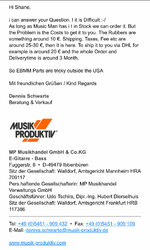
Sadly, it's more complicated that just getting part X to customer Y when international borders are involved. (And this issue applies to MOST manufacturing industries across the world). There is import/export duty, sales tax, warranties, consumer protection laws, shipping insurance/loss/damage/theft, maybe CITES documentation too? Multiply by thousands of customers in 100+ countries with their own laws to follow and languages and currencies? A very small % of the time exceptions are made but otherwise, no, it's impossible. This is why distribution networks exists.
Hypothetical example: EBMM makes a legally binding contract with distributor ABC in country Xyz. ABC gets the exclusive rights to sell EBMM gear to stores in their region. In return ABC provide warranty service and parts to the stores on EBMM's behalf. In case of a warranty issue it's often a store's legal responsibility to make things right for the customer, which means the local guitar store cannot dismiss customers with "talk to EBMM, leave me alone". Similarly, ABC cannot say to stores "not our problem, talk to EBMM". Every person in the chain only has to contact the people closest to them in the chain. Yes, the worst case scenario is...
Customer → Store (→ ABC → EBMM → ABC → Store) → Customer
but usually it's either
Customer → Store
or
Customer → Store (→ CMC) → Customer
...which can be completed faster and cheaper than international shipping of individual packages.
But this also means EBMM have to respect distributor's business with the stores, and the stores' business with its customers. And vice versa! That means nobody can simply sell to anyone anywhere at any time. Not just because of the cost of individual shipping, import/export duty, language, currency, sales tax, warranty, but also because it undercuts everyone else's business. That's bad for everyone in the long run. All this combined is why retail stores or distributors in the US or Australia cannot sell new current production items to customers in India or Peru, and vice versa.
For *really* big companies, or really small companies, it can work differently. e.g. Fender and Gibson are large enough to do things without 3rd party distribution but they own and run their distributors under their own name in many countries. To a customer it might look like Customer → Fender → Customer but that's not really what's happening. But global internet sales are changing the ENTIRE game and *customers expectations* now too. EBMM are trying to get ahead of whatever shift in the industry will happen. It's gonna be an interesting few years ahead I think.
So yes, as a customer it really does seem like "I just want this, but all this *other stuff* gets in the way". Frustrating, yes, but the *other stuff* is necessary for EBMM to exist outside the US at all.
Without it we'd all be playing lower quality Fenders right now, that we'd paid a higher price for.

Thank you for coming to my TED talk.

Time for another coffee. And more guitar playing.








 Let us know how you get on.