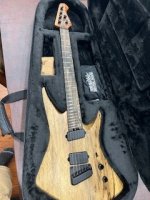
Issue with the nut placement? That's a surprise to me (my absence on other forums notwithstanding), I think I'd remember if someone piped up about it. I'll reach out to CS and see what they have to say for us. (Note that with the compensated nut, nut placement is NOT the same as the theoretical zero fret position. Same is true of PRS and I think Takamine, who also build in some compensation by shifting a standard nut a little forward towards the 1st fret).
I've intonated literally thousands of guitars. With an accurate enough tuner we realize that no guitar ever intonates or plays in tune at every fret. Like everything on a guitar, everything is a compromise all the time. String height at the nut causes problems (which is why open strings are a poor choice of reference but nobody *ever* talks about that). Finger angle, lateral position, and pressure when fretting will change things, and can never flatten a note, only sharpen, so how do we deal with that? And what about how hard we pick/pluck? Do we tune and intonate to the note attack (which is loudest but sharp) or when the note settles down? String pull from some pickups can make things worse. Even then, I tune my lowest string 1 cent flat all the time on all my guitars. How should I intonate that string?
The good news is that intonation has to be seriously off to be a problem so don't sweat it. Remember, of all recorded modern music in the last 70 years, much of it used instruments with worn strings, tuned by ear, and not accurately intonated, and that's before we remember how many guitars didn't have individual string compensation and how much alcohol and drugs were involved in the recordings. Don't get me started on mandolins and ukuleles where the scale length is so short the crown of the fret can affect intonation. So, we just do our best and then forget about it, safe in the knowledge that we're better set up than many of the recordings we love, and get on with the job of playing.
My approach to intonation is this: We usually don't play open strings as much as fretted notes (most of us metal/rock/blues types don't, right?) so we really want the fretted notes intonated reasonably well relative to each other. So I'll ignore the open strings and instead compare the 3rd fretted note to the 15th fretted note (or any two notes 12 frets apart). If the open strings bother me, sometimes I'll intonate again with the open strings and maybe settle somewhere in between. The lowest strings, by virtue of thickness and low tension, can be weird (especially with single coil pickups) and sometimes won't intonate at all, so I'll intonate the highest strings first and eyeball the saddle position of the lowest ones.
Remember, "Perfect is enemy of done".