



Satin neck to gunstock oil/wax?

Sleeping At Sea

Well-known member
Joined
Aug 12, 2021
Messages
80
I have the Bea Sabre and JR Cutlass and absolutely love the gunstock oil/wax neck finish on the necks and I was thinking if I could do something similar with my Kensrue Stringray & Axis Baritone that both have the light satin finish.

Has anyone done this? I have some of the Tru-Oil gunstock oil & wax ready to go but this isn't something I've done before. Any advice would be appreciated!
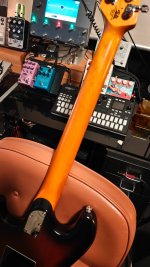
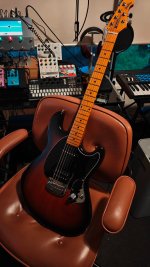
IMG_20260613_171941356.jpg

IMG_20260613_164418817.jpg
 
I would assume you could, have not done it myself but I know others have sanded down finished necks and then applied the oil and wax, try using 0000 steel wool
 
It requires sanding down the existing finish to get to the bare wood. The poly finish is tough so go slow and be careful. It will also cause a lot of dust so best to do it outside.

Ben Eller has a good video, link below, where he goes through the whole process. I make no claims or guarantees so any success or failures are purely yours to own.

 
IMHO, not a very well advised idea, at all. Are you planning on leaving the finish on the fretboard, or removing that too? You could get flaking at the edge of the fretboard if you strip the finish on the back, and not the fretboard.

This is also not a "beginner" level thing to do, unless you want a ruined guitar neck. I'm honestly not entirely sure that Ben Eller actually got through the poly finish to the bare wood. There also may be some type of sealer in the wood, so you are never going to get that same feeling as the oil and wax blend on bare unfinished maple.
 
Thanks for your input all, appreciated. Definitely sounds like some fair risk in attempting this. I thought the satin finish may be quite light and a light sanding may suffice. I"ll have a good watch of the Ben Eller video!
 
IMHO, not a very well advised idea, at all. Are you planning on leaving the finish on the fretboard, or removing that too? You could get flaking at the edge of the fretboard if you strip the finish on the back, and not the fretboard.

This is also not a "beginner" level thing to do, unless you want a ruined guitar neck. I'm honestly not entirely sure that Ben Eller actually got through the poly finish to the bare wood. There also may be some type of sealer in the wood, so you are never going to get that same feeling as the oil and wax blend on bare unfinished maple.

IDK, I'm currently having a convo over on the PRS forum about doing this to my DGT. It's a mahogany neck. Sanding it down and applying the gun oil doesn't sound terribly complicated, and DIY-able if one goes slow. I'll post the link here (it's about re-shaping a neck, but the refinishing with oil like my Luke is also part of the discussion).

 
IDK, I'm currently having a convo over on the PRS forum about doing this to my DGT. It's a mahogany neck. Sanding it down and applying the gun oil doesn't sound terribly complicated, and DIY-able if one goes slow. I'll post the link here (it's about re-shaping a neck, but the refinishing with oil like my Luke is also part of the discussion).

Just be aware that mahogany has a far more open grain than maple. You may need to apply a coat of tru-oil a few times and sand it back. I used to be quite into Carvin / Kiesel guitars, and people loved the Minwax Tung oil finish on maple, but not nearly as much on Mahogany due to the more open grain.

Looking back at some other guitars I own, I'm pretty sure that the back of the neck on a Geddy Lee USA Jazz Bass is a poly finish that has been sanded a bit/ roughed up and had some type of oil finish put on. It's supposed to simulate the feel of a well broken in poly neck.
 
Just be aware that mahogany has a far more open grain than maple. You may need to apply a coat of tru-oil a few times and sand it back.
I agree. There is a reason mahogany is always finished with lacquer or varnish. You can use an oil finish but it's not gonna be Music Man-style wipe-on wipe-off light surface treatment. You'll be doing it like an actual gunstock finish, building up multiple permanent layers of oil to form a hard finish.
 
Back
Top