Some "Music Man" History From George Fullerton.

OT, but..

Well, my great-great grandfather was granted this patent in 1873.

Kinda neat to have that in the family tree. I just found out about it a few months ago.
 
Barry....
Tom designed the preamps period. That doesnt mean the Leo didnt register the patent in his name......Can you add anything new or do you want to beat this sh%t out of this?
 
So...

I know some have mentioned that they miss the Pre-EB MusicMan (StingRay) preamps. What's the difference between the ones used now and the ones Tommy designed? Or is there a difference? Is the same design still being used?

I apologize if these questions have been asked before...
 
The 2 Bander is the same today (electronically) as it was in the Pre-EB period except for a resistor to protect the IC chip. Initially it was an out board component introduced in the latter part of the Pre-EB period. EB latter included the resistor on the actual board.

Physically, the preamp is now mounted a on a crescent moon shaped board as opposed to a rectangular board over previous years.
 
Rod Trussbroken said:
The 2 Bander is the same today (electronically) as it was in the Pre-EB period except for a resistor to protect the IC chip. Initially it was an out board component introduced in the latter part of the Pre-EB period. EB latter included the resistor on the actual board.

Physically, the preamp is now mounted a on a crescent moon shaped board as opposed to a rectangular board over previous years.

Thanks Gav...
 
Mr Light said:
Yes, I agree...

So, if one has a three-band EQ, is the sound altered in any way by the simple fact that it is a three-bander? Does one have better tone than the other?

3-band vs 2-band is a debate as old as P vs J, rosewood vs maple, ash vs. alder, etc. :D

Some people prefer the interaction between just a bass and treble control while others like having the option of a mid control. It's really personal preference. People get taken in by the "more is better," but there is a simple beauty in a two band preamp.


Sez the guy with two four band Bongos. :D
 
bassmonkeee said:
It's really personal preference. People get taken in by the "more is better," but there is a simple beauty in a two band preamp.


Sure...

As I become more and more purest about my StingRay, I now believe more in simplicity, even though my SR4 is a three-band.
 
Well, IMO the patent clears the debate as to whether the 2 banger is a "Cut and Boost" or merely a "Boost" circuit.

My reading of it is that the Bass control is boost only!

With respect to the Treble control, it's both cut and boost.
 
Rod Trussbroken said:
Well, IMO the patent clears the debate as to whether the 2 banger is a "Cut and Boost" or merely a "Boost" circuit.

My reading of it is that the Bass control is boost only!

With respect to the Treble control, it's both cut and boost.

Hmmm... Interesting...:)
 
I would not get all religious with the LM4250 op amp that Leo used. It has really lousy specs other than supply current. This thread: http://www.vintagebass.com/thedudepit/archive/index.php?t-5391.html
says that the op amp was replaced with an LF441 later on - which has much better specs. Maybe there is even something better available now... I haven't kept track of op amp improvements. I would think that the boost in slew rate with the LF441 would result in a better sound with less distortion artifacts. Even when we were just starting out guys would replace the opamp circuit with a JFET circuit that someone was selling at the time.
 
How to amplify an Earthwood?

Hi,
I have an ernie ball earthwood acoustic.

Have you any thoughts on the right way to amplify this bass?
I've tried a K and K with a Fishman Preamp and it isn't really working too well.

Thanks,

Ken
 
I would think that placement would be the most critical aspect of the K+K. I'm not sure it even benefits from a preamp stuck in line after it.

Barry
 
I have found K&K pickups dont drive regular bass amps very well. They get very honky sounding. They seem to respond well to being preamped just because those piezo things work better into a higher impedance than what the bass amp givves it. When I used one on my upright it sounded infinitely better preamped than straight into my rig. OTOH if you have an acoustic rig it should have facilities for handling a piezo right out of the box.
Gosh am I jealous of you having an earthwood!
 
To me anything honky sounding has rounds on it. Put some flats on it.

tk
 
Tommy was forced to go to a young upstart Grover Jackson to make the basses. Grover was the one who introduced the trans finishes. I often asked Tommy why he didn't sue over the suspect necks and he replied "My dady didn't raise me like that".

Hello everyone! I have been bumping into Music Man quite often in my research of Charvel MFG. Here are some points that may be of interest:

Wayne Charvel sold Charvel MFG to Grover Jackson November 10, 1978. At this point they were assembling and reselling components outsourced by various vendors (Boogie Bodies, Dave Schecter, even Fender). Upon purchasing Charvel MFG, Grover changed the direction of the company from being a reseller, to an OEM. His first deal was with Mighty Mite. The idea was to get money rolling in, buy tools, start making necks, then eventually make complete instruments in quantity (in Wayne's era and this early Grover era, they made very few instruments).

Grover somehow got involved with Music Man around this time. I have not asked him directly the details on how it started, but I plan on asking someday. At first, Charvel MFG was provided with parts they had to finish and assemble. When they ra out of wood components, they simply began making them. I am not really familiar with the evolution of Music Man basses, but looking at the era this went down, it appears it may have coincided with the change from 3 bolt to 4 bolt necks.

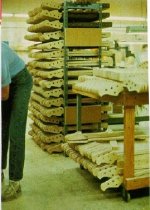
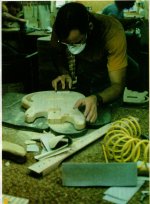
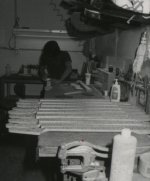
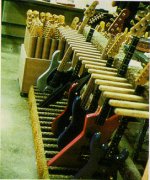
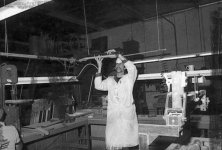
I have Charvel factory photos from 1981 that show Music Man Stingray basses in full production. There are more Music Man bass components than Charvel in the background. The transparent finishes were very popular on the "preproduction" Charvels, so it makes sense Grover introduced them.

I have been trying to figure out when they stopped making Music Man basses. Grover wasn't really sure. He said that they stopped almost all OEM work by 1983-4 as Charvels were in demand and he really wanted to get the Jackson production up and running.

 
Last edited:
Hello everyone! I have been bumping into Music Man quite often in my research of Charvel MFG. Here are some points that may be of interest:

...I have Charvel factory photos from 1981 that show Music Man Stingray basses in full production. There are more Music Man bass components than Charvel in the background...

Pics please.
 
I only have a few on this PC. I will dig for others on my external drive soon. These are from 1981, after Charvel had gone into production. There are earlier pics I will dig up where production was primarily Music Man and BC Rich.

bassnecks.jpg
sandingbass.jpg
mm.jpg
Lower Shelf.jpg

This is Henry Boyle. He headed the neck department. The thing that stood out in his memory most about the Music man's was inlaying the larger than usual dots. Not sure why that stood out to him...

dimas25.jpg
 
Last edited:
This thread is a nice piece of history. Now i understand why 76-79 rays are quite different.
 
Back
Top